
Wind turbines are typically installed on mountain tops and open fields—areas with high lightning strike frequency. The blades are made of fiberglass and carbon fiber composites, which are highly conductive to lightning, while the internal lightning protection circuits remain concealed. Over long-term operation, issues such as poor air terminal contact, abnormal conductivity, and grounding failure frequently occur, leading to blade ablation and turbine shutdowns. These problems not only increase O&M costs but also significantly affect the power generation stability of wind farms. Therefore, routine, high-precision, and safe lightning protection testing is a critical safeguard for the safe production and regulatory compliance of wind farms.

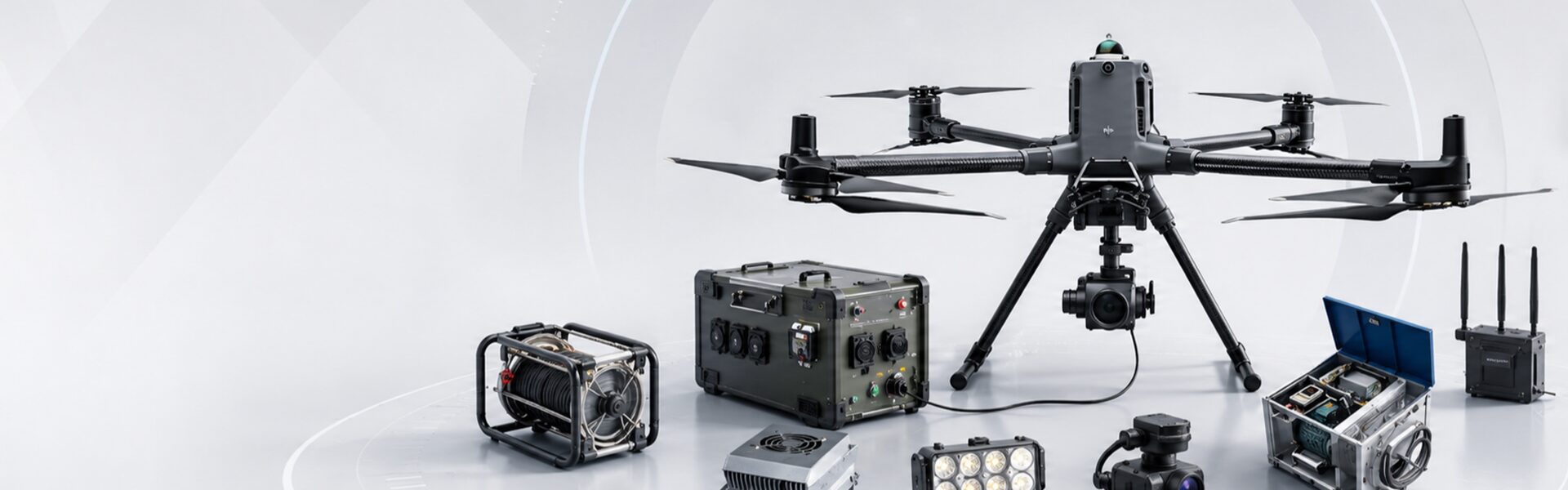
Recently, Airfly Tethered’s comprehensive wind turbine lightning protection testing solution has once again matured into a proven system, successfully delivered to the SDIC Energy wind farm project. The equipment features a standardized conductive copper mesh, with our technical team performing custom structural adaptation, integration, assembly, and on-site commissioning. Combined with our self-developed tethered control system and the FC100 industrial drone platform, the solution effectively addresses various on-site operational challenges in wind turbine lightning protection testing, empowering large-scale wind farms with stable, efficient smart O&M upgrades.
I. Refined Through Real-World Practice – A Mature Turnkey Solution Now Standardized for Wind Farm Deployment
With deep roots in the low-altitude wind power O&M sector, Airfly Tethered has always focused on practical on-site operational needs, rejecting the simple assembly of off-the-shelf components. To address the on-site challenges of unsafe operations, unstable data, low efficiency, and limited adaptability in wind turbine lightning protection testing, we leverage our proven capabilities in system integration, structural modification, and on-site commissioning, combined with years of wind farm project experience, to continuously optimize the entire equipment set and workflow. This delivery to SDIC Energy represents the standardized replication of our refined, mature solution—fully validating the solution’s adaptability to diverse site conditions and its batch delivery capability.

The entire workflow is simple, standardized, and fully intelligent: the FC100 industrial drone, equipped with Airfly’s integrated and optimized conductive copper mesh, precisely conforms to the blade tip air terminals. Paired with the intelligent tethered winch system that automatically pays out and retrieves cables, it establishes a stable ground-to-blade electrical test loop. The entire process requires no personnel to work at height—O&M personnel can complete equipment control, data acquisition, and record archiving entirely from the ground, comprehensively addressing the shortcomings of traditional methods.

II. Core Integration and Optimization – Targeted Upgrades for Real-World O&M Needs
1. Structural Optimization for Conformity – Resolving On-Site Contact Instability and Data Drift
To address issues of poor high-altitude contact, signal drift, and significant data errors commonly seen with generic testing accessories, we have carried out custom structural modifications and integration adaptations based on the standard copper mesh. By optimizing the contact geometry to match the curvature of wind turbine blades and the dimensions of mainstream air terminals, we increase the effective contact area and improve adaptability to blade deformation. During operation, the mesh conforms flexibly to the air terminal points, cushioning flight impact forces without damaging the blade’s paint finish. This effectively resolves problems such as unstable high-altitude contact and poor data repeatability, delivering accurate and traceable test data that fully complies with national lightning protection testing standards.

2. Optimized for the FC100 Industrial Drone – Tackling Complex Wind Farm Conditions and Operational Instability
To cope with turbulent airflow, frequent gusts, unstable hovering, and difficult alignment at wind farm sites, the solution is deeply integrated with the FC100 heavy-lift industrial drone. With ample power, excellent wind resistance, and precise station-keeping, the drone easily handles rugged field conditions, maintaining stable flight attitude and high mating accuracy. This effectively prevents test interruptions and data loss caused by flight jitter, significantly broadening the on-site operational window and improving test success rates.

3. Intelligent Tethered System Upgrades – Eliminating Endurance Limitations and Cable Snagging Safety Risks
Our self-developed tethered winch system features proven, stable tension control logic that automatically pays out and retrieves cables while adjusting tension in response to the drone’s flight status, fundamentally eliminating safety risks such as cable entanglement, slack, and tugging on the airframe. With the advantage of continuous tethered power supply, the system overcomes the endurance constraints of conventional drones, supporting batch testing of large numbers of turbines with stable operation and low failure rates, making it ideal for large-scale, routine wind farm O&M.

4. Unmanned Operation Mode – Solving Long Test Cycles and High Turbine Downtime Losses
The unmanned intelligent testing mode greatly simplifies workflows and reduces test duration. A complete lightning protection test for a single turbine takes just tens of minutes—achieving over five times the efficiency of traditional manual methods. This effectively shortens turbine downtime, reduces power generation losses, and eliminates the high costs of aerial lift rentals and dangerous manual labor, delivering comprehensive optimization across safety, efficiency, and cost.

5. Modular Integrated Design – Eliminating Bulky Equipment and Cumbersome Deployment
The entire system features a lightweight, modular integrated design, allowing quick assembly and disassembly with efficient transport. It can be rapidly deployed across diverse wind farm terrains including mountains, plains, and hills. The solution adapts to a variety of operational scenarios such as routine annual inspections, follow-up re-inspections, and batch sampling, offering strong versatility and flexibility that aligns perfectly with the standardized O&M needs of large-scale wind farms.
III. Technology Refined Through Practice – Empowering with Proven Solutions
The successful delivery of this SDIC Energy project is a powerful testament to Airfly Tethered‘s years of hands-on practice, continuous solution optimization, and proven batch delivery capability. The entire solution—including core control systems, operational logic, and equipment integration processes—has been independently developed and refined. Through targeted modifications, scenario adaptation, and system integration of standard components, we have developed a deployable, replicable, and highly stable lightning protection testing solution for wind turbines.
Looking ahead, Airfly Tethered will continue to deepen its presence in the wind power low-altitude O&M sector, persistently refining equipment integration processes and control system performance, and honing standardized O&M solutions. With professional, proven, and reliable deployment services, we aim to help wind farms achieve intelligent O&M, improve quality, and reduce costs, contributing to the high-quality development of the clean energy industry.
For more information on our wind turbine lightning protection testing solutions, equipment specifications, case studies, and customized O&M services, feel free to leave a message or contact us!
Copyright © 2025 Nanjing Weize Chuangli Electronic Technology Co., Ltd. All Rights Reserved. privacy policy