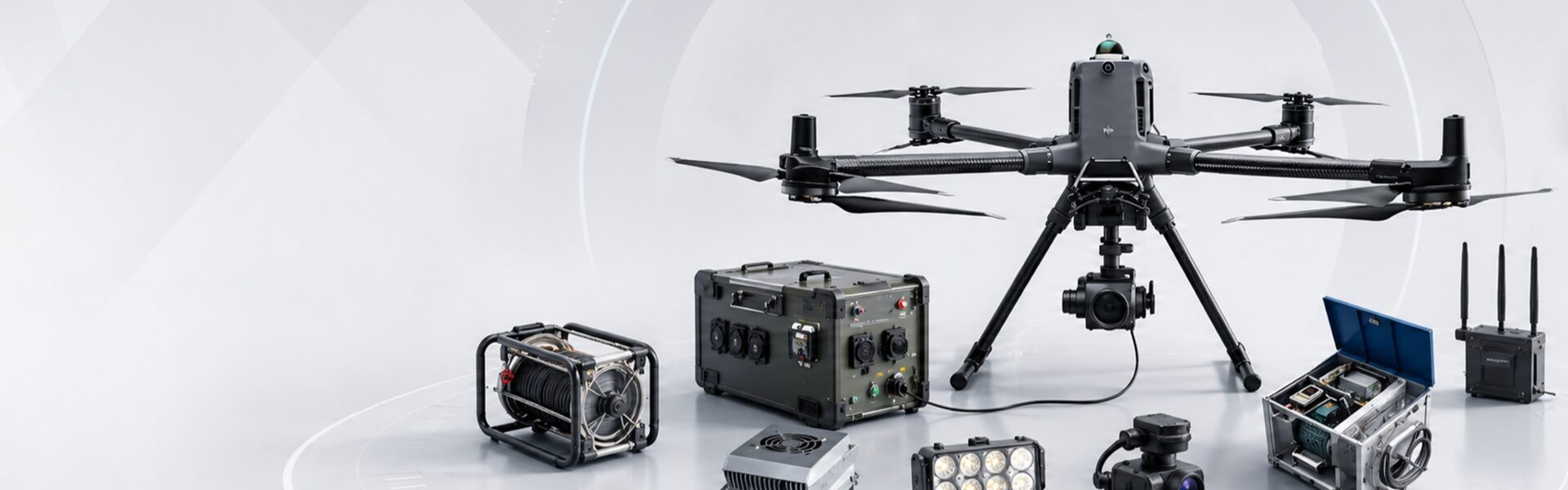
CASE STUDY | AERIAL FACADE CLEANINGPowering High-Rise Curtain Wall Cleaning from the Ground Up:The FC100 Dual-Tether ApproachComplete field deployment: FC100 platform with G40Pro ground power unit, motorized cable reel, and B7X high-pressure water pump.The Challenge: Why Conventional High-Rise Cleaning Falls Short
Maintaining glass curtain walls on high-rise commercial and transportation infrastructure has long been one of the most expensive and hazardous tasks in building operations. Rope-suspended cleaning crews face serious fall risk, require specialist safety certification, and are constrained by weather windows. Even when workers are available, the pace is slow — a single tower facade can take days of manual effort to complete.
Conventional battery-powered cleaning drones partially address the safety issue but introduce their own limitations: flight time rarely exceeds 20–30 minutes per charge cycle, water supply at altitude is inconsistent, and spray pressure drops as the drone climbs. For high-volume facade work, these gaps make battery drones operationally impractical.
Guizhou Transportation Group required a system capable of sustained, high-pressure cleaning across large facade areas — with no workers at height and no repeated interruptions. The solution deployed was Kitefly Tethered's dual-tether architecture: continuous ground power through one tether, high-pressure water supply through a second.
What Makes Dual-Tether Different
Most aerial cleaning systems are single-purpose: they carry either a water spray unit or a sensor — but not both, and not for extended durations. The dual-tether model addresses the two constraints simultaneously that have historically limited aerial facade cleaning:
Power tether: 380V three-phase grid power is converted by the G40Pro ground station into high-voltage DC and delivered continuously to the airborne DF-FC100 power module. The drone never runs on battery during operations.
Water tether: High-pressure water is pumped from the B7X ground unit through the secondary tether line directly to the AF-Q2 airborne spray lance, maintaining consistent nozzle pressure regardless of altitude.
The combined effect is a system that operates like a tethered industrial cleaning rig — with the mobility of a drone and the endurance of a grid-connected machine. Spray pressure reaches up to 20 MPa at working altitude, and cleaning throughput of 800–1,000 m² per hour has been validated in formal acceptance testing.
System Architecture and Component Specifications
The Guizhou Transportation Group deployment integrates four Kitefly Tethered products with the DJI FC100 heavy-lift aerial platform. Each component is purpose-designed for its role in the dual-tether power and water delivery chain.
G40Pro — Ground Power StationG40Pro ground power station: FR4 non-conductive enclosure, 15 kV/mm dielectric rating, active motorized reel.
The G40Pro accepts standard 380V three-phase input and outputs regulated high-voltage DC to the aircraft via the tether cable. The enclosure is constructed from FR4 fiberglass composite — not aluminum — specifically to meet the dielectric requirements of high-voltage aerial power delivery. A motorized cable reel with active rewind and anti-static brush handles cable management during ascent and descent.
Parameter
Specification
Input Supply
380V AC, 3-phase, 4-wire
DC Output Range
0 – 1,000V DC (adjustable)
Rated Output Power
≤ 26 kW
Standard Cable Length
120 m (extendable to 300 m)
Cable Diameter
≤ 6.4 mm
Cable Mass
≤ 4.4 kg per 100 m
Rewind Speed (active)
Up to 2 m/s
Operating Temperature
-20°C to +60°C
Enclosure Material
FR4 non-conductive fiberglass composite
Dielectric Strength
15 kV/mm
DF-FC100 — Airborne Power Conversion Module
The DF-FC100 mounts in the DJI FC100 battery bay and converts incoming high-voltage DC tether power to 58.8V DC for the aircraft and all onboard systems. With rated output current of 400A and conversion efficiency of ≥97%, it can supply both full propulsion power and the cleaning payload simultaneously. Thermal management uses six high-speed fans with forced-air cooling; operating noise does not exceed 60 dB(A).
Parameter
Specification
Input Voltage
800 – 1,000V DC
Output Voltage
58.8V DC
Rated Output Current
400A
Rated Output Power
≥ 24 kW
Peak Output Power
≥ 32 kW
Conversion Efficiency
≥ 97%
Protection Rating
IP65 (key components IP67)
Weight
≤ 9.0 kg
Altitude Rating
0 – 3,000 m
Operating Temperature
-26°C to +40°C
AF-Q2 — Airborne High-Pressure Spray LanceAF-Q2 spray lance: 100 cm retracted / 375 cm extended, rated at 25 MPa internal hose pressure, tool-free nozzle exchange.
The AF-Q2 is a telescopic spray lance designed for airborne high-pressure facade cleaning. A rotary locking collar allows operators to adjust reach from 100 cm to 375 cm without landing the aircraft. The internal hose is rated at 25 MPa, and the nozzle is exchangeable without tools, allowing rapid changeover between cleaning patterns during a single deployment.
Parameter
Specification
Retracted Length
100 cm
Extended Length
375 cm
Internal Hose Pressure Rating
25 MPa
Weight
1 ± 0.2 kg
Inlet Quick-Connect ID
15 mm
Outlet Quick-Connect ID
12 mm
B7X — Ground High-Pressure Water PumpB7X ground pump unit: 5.5 kW motor, 15 MPa maximum nozzle pressure, 17 L/min flow rate, 80-litre onboard buffer tank.
The B7X provides sustained high-pressure water supply from ground level, feeding the water tether line that runs alongside the power cable up to the AF-Q2 spray lance. Its 80-litre onboard buffer tank smooths supply during mains interruptions and reduces pressure fluctuation during active cleaning passes.
Parameter
Specification
Input Power
380V AC, 3-phase, 4-wire
Motor Power
5.5 kW
Maximum Nozzle Pressure
15 MPa
Flow Rate
17 L/min
Water Buffer Tank
80 litres
Dimensions
72 × 62 × 100 cm
Weight
90 kg
Acceptance Test Results — Guizhou Transportation Group
Following system integration and commissioning, the complete deployment was submitted to formal acceptance testing by Guizhou Transportation Group. All performance indicators were verified and confirmed to meet or exceed the original project specification.
Performance Indicator
Acceptance Outcome
Cleaning coverage rate
800 – 1,000 m² per hour — specification met
Productivity vs. manual rope crew
5 to 20 times faster — specification exceeded
Post-cleaning glass light transmittance
≥ 95% restored — specification met
Personnel deployed at working height
Zero — specification met
Continuous operation fault-free test
Full-duration test passed
Safety regulation compliance
Full pass across all applicable standards
Why Operators Choose Tethered Over Battery-Drone Cleaning
The operational case for tethered aerial cleaning is straightforward in environments where facade area is large, access is restricted, and work duration requirements exceed 30 minutes. Battery drones require frequent landing cycles for swaps, which creates cumulative downtime and increases deployment cost. Beyond endurance, the pressure differential between ground-pumped water and self-contained airborne tanks is significant: the B7X delivers 15 MPa at the nozzle; most compact airborne water systems operate at 2–5 MPa.
For full-facade campaigns at transportation hubs, commercial towers, and industrial facilities, this pressure difference is the deciding factor between cosmetic cleaning and genuine maintenance-standard results.
Target Application EnvironmentsHigh-rise office and commercial towers: Glass curtain wall maintenance, post-construction cleaning, and scheduled facade cycles.
Transportation infrastructure: Airport terminal facades, railway station glass canopies, and multi-level interchange structures.
Large atrium and roof glazing: Overhead glass structures where rope access is impractical and ground-reach equipment cannot achieve coverage.
Industrial facility exteriors: Warehouses, power plants, and processing facilities with large painted or coated wall surfaces.
Bridge and infrastructure maintenance: Cable cleaning, structural surface maintenance, and inspection-combined cleaning passes.
Contact Kitefly Tethered
Kitefly Tethered develops and manufactures tethered power systems for industrial drone operations, including cleaning, firefighting, surveillance, lighting, and long-duration aerial deployment. Engineering support, system integration guidance, and technical documentation are available for international distributors and project developers.